




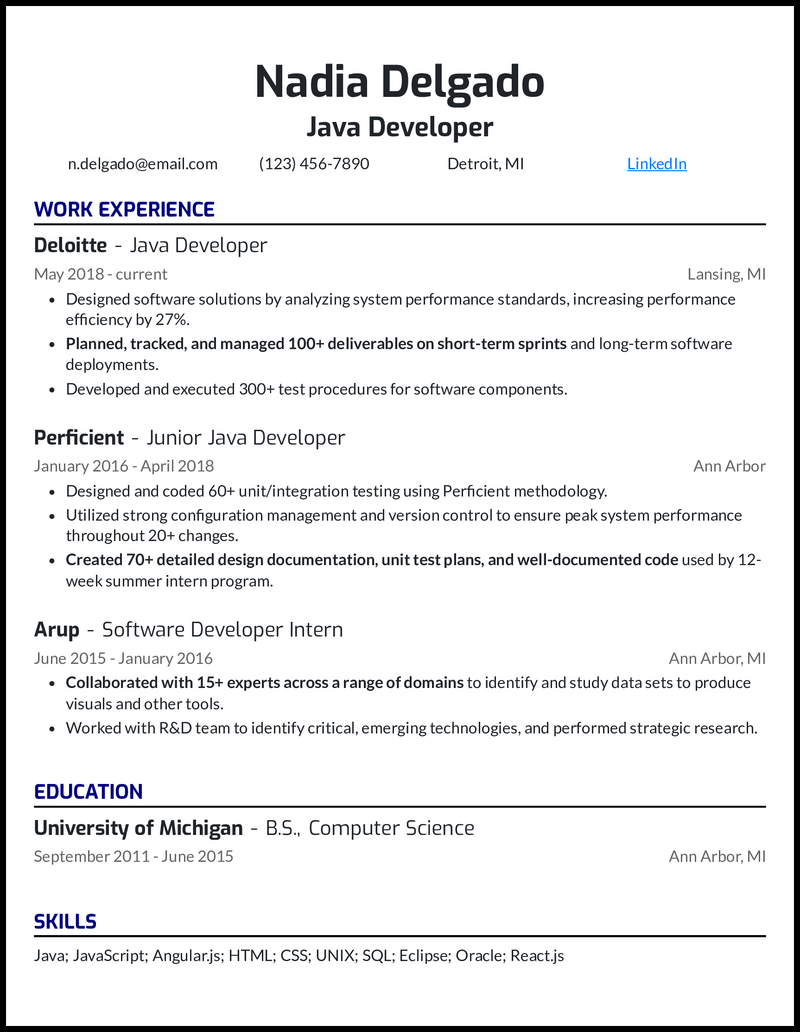
Write a Java developer resume that gets you more than a slot in the interview list, confidently showcase your technical chops from relevant past roles and successful projects, and include the measurable results.
Often update your resume and ensure it has all the key sections, detailing your career journey, educational background, past wins, and core Java skills. Also, create a cover letter to add context to pertinent past roles.
This guide covers:
- ↪ 17 Java developer resume examples
- ↪ Resume formatting tips
- ↪ Beating the ATS (Applicant Tracking System)
- ↪ What to include in your contact info
- ↪ Choosing and listing your top Java skills
- ↪ Writing project and experience sections
- ↪ Tailoring resumes for different Java roles
- ↪ Certifications and education to include

Why this resume works
- When making an online resume, it’s important to keep your goal in mind: to quickly make the case to the hiring manager that you deserve an interview. The best way to make this case is to use numbers to describe your accomplishments.

Why this resume works
- An average corporate job ad is said to attract over 200 applications. Sounds daunting, but here’s the playbook to leave the competition in your dust and clinch that job: accentuate your proudest accomplishments but keep it slick— there’s no need to lay them on too thick—short and with just the right amount of punch.
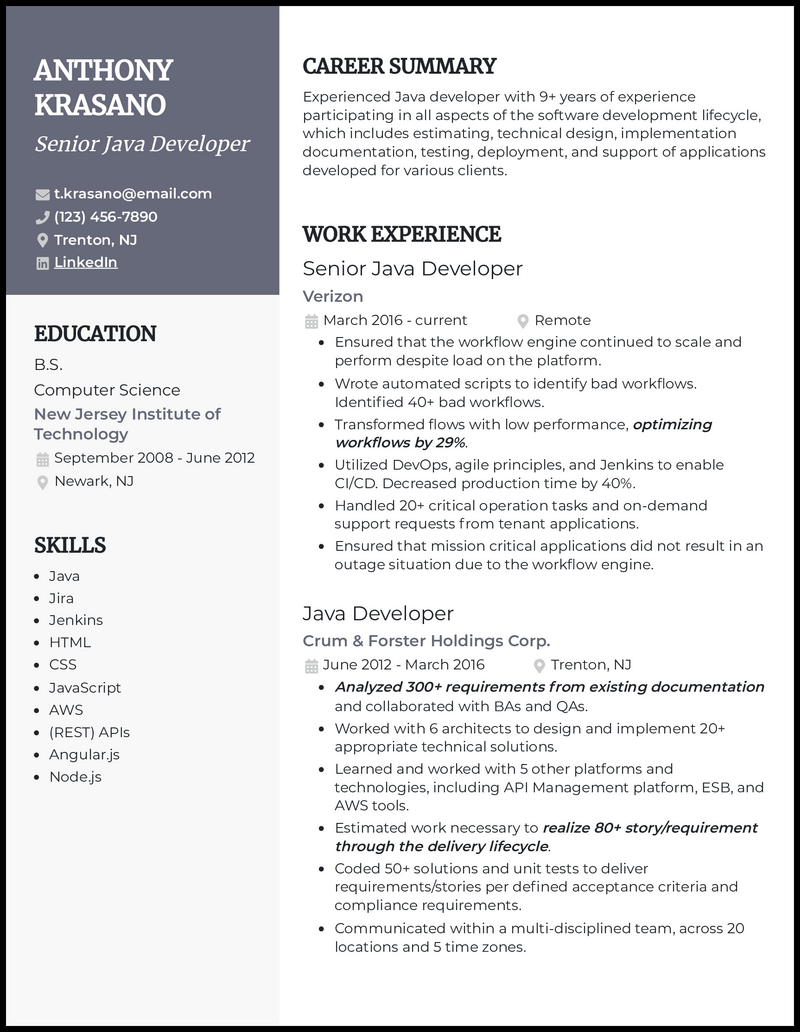
Why this resume works
- When determining which Java frameworks to include on your senior Java developer resume, read the job description of the role for which you’re applying.
- Your web developer skills need to strike the right balance between being an exhaustive laundry list and completely missing the languages or frameworks with which you’re experienced.
See more senior Java developer resumes >

Why this resume works
- A backend developer keeps systems running smoothly from behind the scenes—which is no small feat.
- Holding a notoriously challenging certification like Oracle’s Java SE 11 is well worth including on your Java backend developer resume to prove you know your stuff.
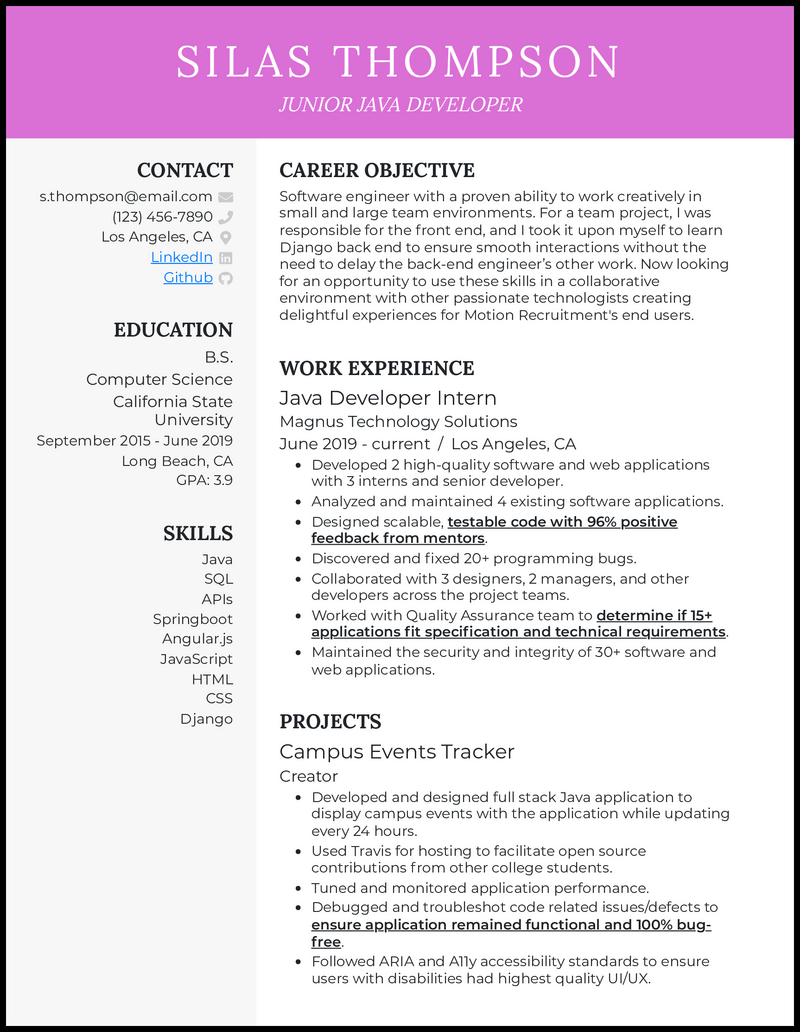
Why this resume works
- In your junior Java developer resume, consider adding a resume objective to give employers a brief (two to three sentences) yet engaging snapshot of your personality and capabilities.
- This means you should tailor them to each position you apply to (use the job description for keywords) and mention the company by name.
See more junior Java developer resumes >

Why this resume works
- Before you click the submit button, take a moment to rethink your Java AWS resume’s structure—it’s as important, regardless of how persuasive your arguments can be. Add a section for your academic qualifications, certifications, and skills that make sense for the role.

Why this resume works
- Lying on your Java Spring boot resume is a surefire path to trouble. After all, the cringe that will wash over you when a sharp-eyed recruiter uncovers these embellishments is not worth the risk. And of course, you’re not looking at jail time for this, but you’ll certainly watch that job slip through your fingers.

Why this resume works
- As a lead, you’re the team’s go-to IT person, so make sure your lead Java developer resume highlights skills that truly matter. List the frameworks and platforms you’ve mastered, such as Hibernate, Spring, or Docker—but don’t start writing a tech encyclopedia.

Why this resume works
- Don’t let employers brush over your Java developer with GCP resume because of a cramped design. Think of it like Java code—no one will bother looking at it if it’s messy and complicated to read.
- Use a spacious layout, like the Official template, that lets your best work experience, skills, and education shine without leaving the reader gasping for air.

Why this resume works
- When crafting your Java API developer resume, remember to include a tech degree like a Bachelor of Computer Science to grab the attention of employers.
- It’s proof that you didn’t just pick up coding from YouTube tutorials but have professional education in handling API integrations.

Why this resume works
- Showcasing your familiarity with relevant tools and technologies on your Java UI developer resume marks you out as an invaluable asset in an industry that continually evolves. Think along the lines of software programs and frameworks like JavaFX, Dropwizard, Angular, and Apache Maven.
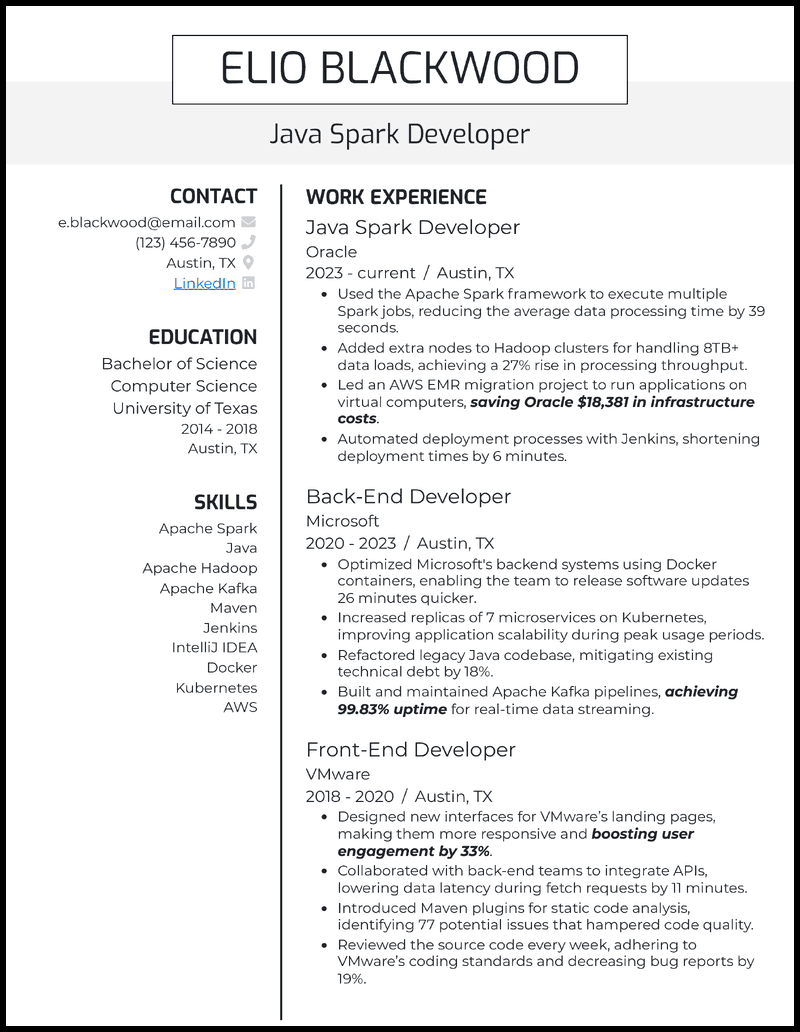
Why this resume works
- Ready to prove that you’re the go-to Spark maestro? Let your metrics do the talking on your Java Spark developer resume. Impacts, such as saving infrastructure costs or analyzing large datasets highlight your knack for using Spark frameworks to deliver real-world results.

Why this resume works
- If you have experience designing the user interface on a widely-used platform—like Lyft or Netflix—place those positions prominently on your Agile Java developer resume to quickly gain recognition from recruiters.

Why this resume works
- Your Java developer with Kotlin resume becomes a timeline of triumphs by using a reverse chronological format. Show employers how you climbed the ranks to master Kotlin, proving you’re not just a developer but the evolution of one.

Why this resume works
- Check out Maeve’s Azure Java developer resume and how it leaves no stone unturned by covering everything from Azure App Services to Azure Cosmos DB, giving employers a clear idea of her capabilities. Overall, if you’ve got the cloud skills, don’t be shy: let ‘em rain down!

Why this resume works
- Have the primary job title on your entry-level Java developer resume (right under the name in this resume) exactly match the role you’re applying to as a developer. Also, include your experience with development in your resume objective (if you decide to include one, which you don’t need to do). Also list relevant projects, activities, or hobbies that show employers your interest and initiative in the field.
See more entry-level Java developer resumes >

Why this resume works
- When you’re applying for a specialized role, make sure the title on your full-stack Java developer resume (below your name) matches the job title of the role found in the business job description.
- Next, discuss any frameworks you’ve used (like Spring) and the scope of the projects in which you used Java. This is the time to put some context around your Java experience.
See more full-stack Java developer resumes >
Related resume guides
How to Tailor a Java Developer Resume to the Job

Your Java developer resume must present your technical prowess, ability to work with teams, and the business value you bring to projects.
Summary
Master the art of writing a winning Java developer resume by tailoring it to job descriptions, showcasing relevant skills, formatting for ATS, and highlighting measurable achievements, projects, and clean design.
To stand a better chance of getting the job, highlight your core Java skills, accomplishments from past work, and relevant training while tailoring your resume to the job you’re applying to.
Let us show you how to:
- Format your resume for HR managers and ATS
- Integrate relevant keywords
- Grab recruiters’ attention with a compelling professional profile
- Packaging bullet points in a complete, impactful way
- Demonstrating impact from projects
- Assemble your technical and soft skills for a Java developer
- Leverage your training
- Align your document to the job’s expectations
You’re a wizard when it comes to writing complex lines of code that seemingly make the magic happen. It’s totally okay if writing a resume doesn’t come as naturally. Fortunately, the best way to succeed is to just focus on the job description, and the most interesting part by far is the “job responsibilities” section.
What do employers generally want from Java developers like you, you may wonder? We’ve done the legwork and combined the most popular job responsibilities in your field to help you perfect your resume!
- Design, develop, and maintain software and services using Java, Python, and C++
- Write clean, efficient, and scalable code to meet back-end and full-stack requirements
- Perform code testing and debugging, describing and resolving performance issues or bugs
- Optimize application performance by tuning the JVM, implementing caching mechanisms, and refining SQL queries
- Participate in code reviews, daily stand-ups, and stakeholder meetings to ensure project completion and progression
- Follow DevOps best practices to provide timely deployment in accordance with company policies

Reverse-chronological format, functional format, and combination/hybrid format
The most popular formats in 2026 are reverse-chronological, functional, and combination/hybrid. Online tools like our resume formatting guide can help you format your resume in minutes, but it’s still worth understanding the basics.
- Using the reverse-chronological format, your most recent, relevant position would be at the top of your resume, with previous work following in reverse-chronological order.
- Using functional format, list your skills first. Then include employment history arranged by job function (e.g., sales manager).
- Next, you would add education, followed by other information in any order you choose. Employ a functional format when you’re trying to change career paths.
- To implement a combination or hybrid of functional and reverse-chronological format, skills and work history are equally balanced. List skills after contact information, but emphasize work history, as well.
- The reverse-chronological format is the best choice for a Java developer resume because it ensures that recruiters can see your most recent work history first in an easy-to-read timeline

Including the right contact info
Contact information is an essential part of your resume. Include a logical flow of information that will help recruiters reach you easily. Our resume examples can teach you what you need to know! Contact information should be located near the top of your resume. Your Java developer resume should include:
- Your name and job title you’re seeking
- Phone and email
- City and state are optional
- Social media links are optional but can help the employer discover more about you if needed

Beat the ATS
Oracle’s resume writing guide lays emphasis on having aa functional resume structure, which is the second most important thing (after keywords) when online bots screen your resume. Applicant Tracking Systems (ATS) scan resumes for AI-friendly designs and keywords related to the job description, so it’s important to format your Java developer resume with keywords in mind. ATS scans for patterns and analyzes the content of the resume. If your resume lacks keywords or is formatted improperly, you may be automatically filtered from the applicant pool.
Essential tips to getting past the ATS:
- Margins: The role of margins in formatting your Java developer resume is to ensure the text looks neat and clean. Place one extra line between each paragraph for better readability. The top, bottom, and side margins are typically 1 inch.
- Fonts: The most common fonts used in resumes are Times New Roman, Arial, or Calibri, with 10-12 points being standard.
- Header names: The headers in your resume should be bolded and consistent.
- Skills: The skills section in your Java developer resume should comprise three to five keywords related to the job description for which you’re applying.
- Reverse-chronological order: Use reverse-chronological order of information for easy reading. The progression should be from the most relevant and recent experience at the top to a flow of less recent work history.
- Alignment: The alignment of your Java developer resume will help it look crisp. For just about everything, you’ll want to align your text left. Your contact header can break this rule, though, if you like.
- One page: Keep your resume a burden-free one page. Recruiters are busy people!
Keep your resume from being filtered by either the ATS or a swamped hiring manager with proper, tidy formatting. Our free resume builder can help you format your resume correctly. It will take you through the process of building a perfect Java developer resume in no time!
How to Write a Java Developer Resume

Writing an effective Java developer resume may seem like a daunting task. Taking it step by step and using our resume builder will set you on the right track and ensure that you have all the key components. While writing your resume, consider the following:
- What about a resume objective or summary?
- Job experience
What about a resume objective or summary?
- Add an objective to your Java developer resume if you lack experience or change careers. It can add fullness to a thin resume.
- Objectives should be concise and to the point, giving a glimpse of what you can offer.
- Use a summary to highlight your most significant experience, skills, and specializations.
- A summary works well when you’ve worked about 10 years or more in your field.
- The summary gives recruiters a quick, focused glance at your solid expertise and achievements.
- Objectives and summaries can provide strategic snapshots to hiring managers looking to weed through applicants quickly.
- You can omit an objective if you have many years of experience, aren’t changing careers, or don’t intend to customize your resume for each position to which you apply.
- A summary is helpful if you have special achievements and many productive years to highlight but is optional.
Example of a poor, vague objective
Seeking a job as an Android developer
Example of a poor, vague summary
Worker with more than 5 years of experience as a full-stack developer
Vague objectives and summaries fail when they lack depth and specifics. Customize yours to the job you’re applying for and mention that company by name. Summaries should highlight the numerous positions you’ve held and the impact you will offer the next business, should they be savvy enough to hire you.
Examples of good objectives:
- Experienced Java developer who dreams in Java and has a solid grasp on web services and complex application development. I am excited to continue my career by joining a company composed of driven professionals who value creative problem-solving and strive to revolutionize AT&T’s services.
- Software engineer with a proven ability to work creatively in small and large team environments. For a team project, I was responsible for the front-end. I learned Django back-end to ensure smooth interactions and am looking to use these skills in a collaborative environment with other passionate engineers at Pixar.
Examples of good summaries:
- Proven 8+ year full-stack Java developer with a passion for learning and working with new technologies that positively impact society. Proficient in Java and JavaScript performance and teaching. Dedicated to learning better ways to write clean, efficient code while keeping up with the latest tech stacks. Searching for my next Java developer role at Google that will leverage my expertise in creativity, analytics, and problem-solving.
- Experienced Java developer with 9+ years of experience participating in all phases of the software development lifecycle, including estimating, technical design, implementation, documentation, testing, deployment, and support of applications developed for various clients. Looking forward to mentoring and leading a team of developers and collaborating with multidisciplinary teams at Peterson Technology Partners to transition to cloud technologies.
Though rarely done well, a good summary or objective is specific and chock full of information to help hiring managers narrow applicants. These resume objectives and summaries are successful because they focus on relevant information, are customized to the employer, and include keywords that directly relate to the job.


Job experience
It’s best to include two to four job experiences in reverse-chronological order. You don’t need to include every position you’ve ever held in your life. Instead, focus on those relevant to the position to which you’re applying. Begin with your most recent role, as it will provide a good idea of your skillset and experience.

Writing your job description bullet points
A keyword scanner can ensure your job description bullet points are clear, concise, and contain keywords that link you to the job for which you’re applying. The language on your Java developer resume should be simple with consistent punctuation. For example, if you end one bullet point with a period, continue that format throughout. Avoid using personal pronouns, and remember to use active verbs for impact.
Poor bullet points in your Java developer resume:
- Software developer for 5 years
- Focused on building automated test suites and creating documentation
- Worked with a team of developers to integrate features into the system
These bullet points fail because they lack depth, specifics, and keywords. They’re also void of stats and examples of work or achievements.
Good bullet points:
- Collaborated with a team of 12 to ensure that the workflow engine continued to scale and perform well
- Created 65 automated test suites and coded automated tests while documenting features and functionalities of the system to better educate other developers
- Used DevOps and Agile principles with a team of 5 other developers, optimizing workflows by 35%
Your bullet points should provide metrics, examples of achievements and be concise while showing the employer your impact.

Quantify your impact
Quantifying your impact on your Java developer resume is an effective way to highlight your experience. Include numbers such as how much time you saved the company by automating a task, how many clients you had, and how much revenue you generated.
Ways to incorporate metrics into your bullet points include:
- Time Saved
- Example: Designed and created automated test suites that ran over 500 tests in 7 minutes, saving 40% of process time
- Revenue Generation
- Example: Generated $10,000 in new revenue by writing and publishing a range of in-depth technical articles
- Number of clients/customers
- Example: Managed a portfolio of 26 clients who generated 2.5M in annual revenue

What about when you’ve no Java developer experience?
As long as the job description doesn’t explicitly demand direct work experience, nothing should prevent you from writing a resume that lands you the job. A good strategy is to focus on transferrable skills from projects, practical coursework, internships, and voluntary work. If you can underline your contribution to such activities, you can convince recruiters of your potential to thrive once hired.
Technical skills
- Webservers: JBoss, Tomcat
- Languages: SQL, Java, J2EE
- Tools: ClarifyViewer
- IDEs: WebLogic, Eclipse
- CRM Technologies: Save Bean, Worker Beans
- Technologies: EJB, Spring, JDBC
- Version Control Systems: Tortoise, ClearCase
- Application servers: Oracle, WebSphere
Top Java developer skills
Java is one of the most in-demand skills because it allows developers to work on the back-end server-side of coding. Listing hard and soft skills can dress up your Java developer resume. Hard skills can be linked directly to a project. Soft skills are more about your personality and attitude and are harder to quantify. Hard skills show your ability to do a specific job, whereas soft skills give employers an understanding of who you are.
Java developer hard skills can include:
- Programming languages such as Java, Scala, and Python
- Frameworks such as Spring Boot, Hibernate, JavaServer Faces
- Configuration tools such as Maven, Gradle, Ant
- Languages such as SQL, HTML, CSS
- Operating systems such as Windows and Linux
Java developer soft skills can include:
- Analysis
- Communication
- Quick learner
- Organization
- Detail-oriented
- Patience
- Collaboration
These soft and hard skills are important because they show employers that you have the right attitude and personality for the job. They also give a solid glimpse of your technical knowledge, work ethic, and how well you can work within a team. Try to include a hybrid of at least 6 but no more than 10 soft and hard skills.

Use impactful power words
You can turn your work experience bullet points into wins by starting them from a point of action. This means using verbs to demonstrate your rich abilities and create a holistic profile that can take on various projects of different natures and scopes.
Here are some handy verbs that can propel your Java developer resume to the top of the stack:
- Developed
- Organized
- Generated
- Decreased
- Prevented
- Updated
- Verified
- Fostered
- Lowered
- Enhanced

Education, certifications, and licenses
It’s important to read the job description thoroughly to see whether the employer requires certifications. Include any relevant licenses or awards in your resume. For example, if you’re a certified scrum developer, list it! Entry-level Java developer resumes should include education near the top. However, if you boast many years of experience, education becomes far less significant and can be deprioritized toward the bottom. If you have one year of experience AND a BS, education simply doesn’t matter beyond “BS in CS from the University of Location.”

What about projects, interests, or hobbies?
It’s important to read the job description thoroughly to see whether the employer requires certifications. Include any relevant licenses or awards in your resume. For example, if you’re a certified scrum developer, list it! Entry-level Java developer resumes should include education near the top. However, if you boast many years of experience, education becomes far less significant and can be deprioritized toward the bottom. If you have one year of experience AND a BS, education simply doesn’t matter beyond “BS in CS from the University of Location.”
Most Java developer resumes won’t include projects or hobbies, but having this information can add fullness. If you’re light on experience or fresh out of college, consider including a project, interest, or hobby relevant to Java programming. Projects are great for entry-level positions because they demonstrate that you have created a product from scratch. You can show employers that you have the initiative to create something and write code.
Entry-level Java developer project examples:
- Interests/Hobbies
- Volunteered to lead a weekly competitive Sudoku club
This example shows you know how to problem-solve. You volunteered at a local organization to solve their security issues and better their establishment.
- Projects
- Hosted a weekly 13-member tech meet-up, where we designed and patented a new coaching app for dog trainers
This example demonstrates your initiative, communication, and collaboration skills, which impress any hiring manager.


Customize your Java developer resume
To land that coveted Java developer role, customize your resume for every job to which you apply. This means tailoring your Java developer resume to meet the job description. Your objective, experiences, and skills should be hand-tailored to precisely reflect the job description of the position you’re seeking.

Edit your Java developer resume
Most people overlook editing when crafting their Java developer resume. Don’t make the same mistake! To increase your chances of scoring an interview, you need to edit and format your resume properly. It should be error-free. The idea is to make your resume as neat, clean, and professional as possible. Ask other people to review it and provide feedback. You can also take advantage of our free resume checker if you’d like some help.
Java Developer Resume FAQs

Besides listing your technical skills in a short resume section, show how you put those skills to the test when talking about your work experience as a Java Developer.
If Jenkins is something you know and it’s mentioned in the company’s job ad, talk about how you used Jenkins to enable CI/CD. Or maybe Angular is really crucial for a company, so you discuss how you worked on a customer-facing insurance app to build conditional components in Angular.
Any Java developer resume without technical skills will not make it past the ATS. You need a blend of skills, including languages, frameworks, technologies, and tools pertinent to your everyday job. Listing these skills isn’t enough; you must be sure you’ve used them to make an impact and pair them with achievements from past jobs to showcase your value as a developer.
It’s a bit of a loaded question. First, exclude soft skills (strong communication, problem-solving, etc.) from your resume skills section because this short list really only leaves room for you to hit the best of your technical skills (programming languages, frameworks, etc.).
However, use your job description bullet points to showcase soft skills in action. For example, if you discuss writing clean, maintainable, scalable code, you’re attesting to your attention to detail.
If you’re wondering how to fill out a resume when you’re light on work history, the answer primarily lies in projects. As a Java developer, think about how you found yourself in this field, to begin with.
Did you tinker around on personal or academic projects, such as building a word counter or developing a real-time tracker for university events? Don’t overlook these kinds of projects, as you can list them on your resume in bullet points just as you would with your job history.
It’s a 2-3 sentence snapshot of your skills, top achievements, and career goals at the top of your resume to instantly convince recruiters of your fitness for the job. For most Java developer resumes, you don’t need that statement unless you have a decade or more of work experience and outstanding achievements to back that up.
Example:
Senior Java developer with a long, impressive experience building scalable, high-performance commercial programs. Expert in Java, Spring Boot, Microservices, REST APIs, and cloud platforms (AWS, GCP). Pioneered a 20-million-user payment processing system that reduced transaction latency by 62%. Dedicated clean code, mentorship, and smart solutions that deliver impactful software.
While you may have a limited work experience, your junior Java developer resume must come strong with a tech stack. However, name dropping software and tools won’t cut you some slack unless you show what you’ve done or can do with your expertise.
This means showcasing impact from personal/group projects, entry-level positions, internships, and community service relevant to the position you’re applying for.
Land your next job with our AI-powered, user-friendly tool.
Gut the guesswork in your job hunt. Upload your existing resume to check your score and make improvements. Build a resume with one of our eye-catching, recruiter-friendly templates.
• Work in real-time with immediate feedback and tips from our AI-powered experience.
• Leverage thousands of pre-written, job-specific bullet points.
• Edit your resume in-line like a Google Doc or let us walk you through each section at a time.
• Enjoy peace of mind with our money-back guarantee and 5-star customer support.